How to Style a Bookshelf With Baskets (Shelf by Shelf)
How to style a bookshelf with baskets: measure each shelf, anchor the bottom with your largest baskets, keep the top light and fix a cluttered or bare look.

A basket or two can help a crammed bookcase or a sparse one. On the first it hides the jumble; on the second it fills the gaps where the books have thinned out. The trouble starts when every shelf gets one, and the bookcase begins to look like a storage aisle.
Work from the bottom up instead. Measure first, put your largest baskets on the bottom shelf, add one or two smaller baskets or lidded boxes to the middle shelves, and keep the top shelf light. Heavy-looking pieces go low, lighter ones higher, and some space stays empty on purpose.
The baskets named below are all ours, handmade in Thailand, and every measurement is copied from the product listing.
Step 1: Measure each shelf before you choose a basket
This is the step most likely to spoil the look if skipped. A basket that juts past the front edge or scrapes the shelf above looks wrong however nice it is.
For every shelf you might use, measure the depth (front edge to back panel), the height (shelf to the underside of the shelf above) and the width (side to side). Note them shelf by shelf, because shelves on one bookcase can differ.
Then compare with the listing:
- Depth: run a rectangular basket lengthways along the shelf, then check its width against your shelf depth.
- Height: leave a finger or two of space above the rim so you can tip the basket and slide it out.
- Width: add up the baskets you want side by side and leave a small gap between them.
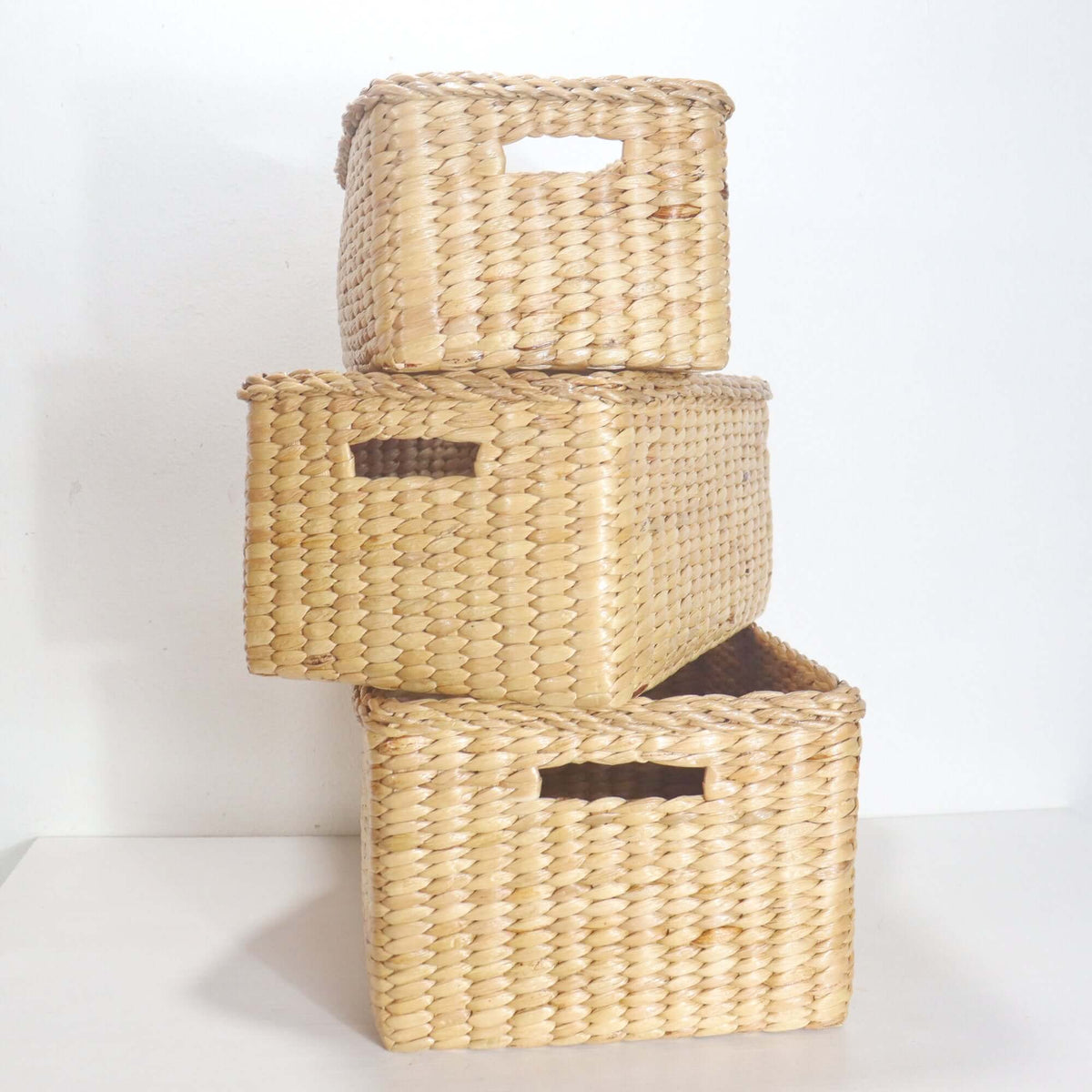
Take our NALARAT seagrass basket boxes, which come in three rectangular sizes:
| Size | Width (shelf depth it needs) | Length (shelf width it takes) | Height |
|---|---|---|---|
| Large | 27 cm / 11 in | 38 cm / 15 in | 20 cm / 8 in |
| Medium | 25 cm / 10 in | 35 cm / 14 in | 17 cm / 7 in |
| Small | 20 cm / 8 in | 31 cm / 12.5 in | 15 cm / 6 in |
On a shelf shallower than 27 cm / 11 in, the large box will overhang, so check the medium or small next.
Our guide to basket sizes also covers round versus square. Then browse our storage baskets and rule out anything too deep or too tall before you think about looks.

Step 2: Anchor the bottom shelf with your largest baskets
Visual weight means how heavy something looks, not what it weighs. Big, solid, tightly woven or darker pieces look heavy; small, open or pale ones look light. Keeping the heaviest-looking things at the bottom tends to make a bookcase look settled, while a large basket up high can make it look top-heavy.
Two or three matching baskets in a row, such as the NALARAT boxes above, read as one calm block rather than separate things.
On a cube unit, measure the opening of each cube and compare it with a square basket. Our NATNALEE square storage basket is 22 x 22 cm / 9 x 9 in and 20 cm / 8 in high, with side handles; its listing suggests magazines, photos, toys and craft supplies.
The same low-baskets idea works under a console table too.
It's done when no basket overhangs the front edge and each one slides out without catching.

Step 3: Add smaller baskets and lidded boxes to the middle shelves
Give each middle shelf one or two woven pieces at most, and stagger them. If a basket sits on the left of one shelf, put the next on the right of the shelf above. Your eye then zigzags across the bookcase instead of running down a column of baskets, which is what makes shelving look like storage.
Three shapes work here:
- A small open basket at the end of a row of books. Our Danika rattan storage basket is handwoven from 100% natural rattan in three sizes, from 12 cm / 5 in high and wide up to 20 cm / 8 in high and 17 cm / 7 in wide, and its listing names decorative items among its uses.
- A lidded box at eye level. Our SA NA rattan storage box with lid has a fitted lid and woven handle and measures 13 cm / 5 in wide by 9 cm / 4 in high.
- A round basket among straight spines. A row of books is all straight lines, and a round shape breaks them up. Our handwoven round rattan basket has a honey-toned finish and comes in Small, 15 cm / 6 in wide and high, and Large, 20 cm / 8 in wide and high.

Step 4: Style the open shelves around the baskets
Start with the books. Stand some upright in rows and lay others flat in short stacks of three or four. A flat stack doubles as a riser: put a small vase or candle on top to lift it above its neighbours.
Group small objects in threes rather than pairs; odd numbers tend to look more relaxed. If you have lots of little things, gather them on a tray so they read as one shape. Our Wan Nee rattan tray is 100% natural rattan, 17 x 11 cm / 6 x 4 in in the small size and 24 x 16 cm / 9 x 6 in in the large. There are more shapes in our wicker trays and baskets.
Add one plant, trailing or upright; with baskets already adding texture, one is usually enough. Then leave a hand's width or more of empty shelf on each level, so the bookcase doesn't look packed.
Each open shelf should end up with upright books, a stack or group, and a gap.
Step 5: Keep the top shelf light
Limit it to a few small objects and avoid anything big or dark that pulls the eye upward. A basket only works up here if it's one of your smallest and holds light things you rarely need. As a check, the top shelf should hold fewer pieces than any shelf below it.
Match or mix?
One material repeated across the bookcase looks calm, for example all seagrass or all rattan. Mixing works too, as long as the tones stay close; it usually looks busy once three or four materials and colours meet on one bookcase. To keep to one material throughout, start with our seagrass baskets.
Adjust it for your shelf type
- Cube units: put baskets in some cubes, not all. A chequerboard of basket and open cubes looks less like a wall of drawers.
- Built-ins: treat each bay as its own bookcase and repeat the basket positions across bays so the wall reads as one.
- Ladder shelves: if yours narrows towards the top, put larger baskets on the deep bottom shelf and trays or small boxes higher up.
- Floating shelves: with no sides, a basket at one end of a row can act as a stop for the books.
If it looks cluttered or bare
If it looks cluttered:
- Baskets stacked in a column: move every other one to the opposite side.
- Every shelf full: take one or two things off each shelf and leave the gap.
- Odd sizes side by side: swap in matching baskets of the same height.
If it looks bare:
- Not enough baskets: add a row to the bottom shelf first, then one piece to a middle shelf.
- Too much empty space: lay some books flat and top a stack with an object.
Finally, look from across the room. If your eye starts at the bottom baskets, zigzags up through the middle and rests on a quieter top shelf, you're done. For other rooms, see our guide on how to decorate with baskets.
FAQs
How many baskets should go on a bookshelf?
There's no fixed number. A row of two or three on the bottom shelf, plus one or two on a few middle shelves, is a sensible starting point. Use fewer on a small bookcase.
What do you put in bookshelf baskets?
Bulky things you don't want on show, such as blankets, toys and paperwork, go in the bottom baskets. Lidded boxes and smaller baskets in the middle suit chargers and other small odds and ends, and an open basket higher up can hold something decorative.
How do I keep woven baskets on shelves looking good?
Dust them when you dust the shelves, so dirt doesn't settle into the weave. For a deeper clean, see our guide on how to clean wicker baskets.