Wabi Sabi Decor: What It Means and How to Bring It Home
What wabi sabi means, what it is not, and how to bring it home with a few handmade natural pieces for light, walls and shelves.

Wabi sabi is a Japanese way of seeing beauty in simplicity, in imperfection and in the way things change over time. In a room, wabi sabi decor means natural materials left with their texture, pieces that show the marks of the hands that made them, and fewer things with more space around them.
Three ideas are usually used to sum it up: imperfection, impermanence and simplicity. You don't need a room full of new things to get the look, just a few chosen pieces in the right places. Below, you'll see where a handmade piece can go (ceiling, wall, shelf) and how to read a listing for real handmade variation.
Where we suggest a piece, it's one of ours, handmade in Thailand, with sizes taken from its listing.
What wabi sabi means
Wabi sabi has its roots in Japanese culture and is closely associated with the tea ceremony and with handcrafted objects. In a home, it asks you to value a piece for its material and for the visible signs of how it was made.
The three ideas, in plain terms:
- Imperfection. An uneven rim, a slightly irregular weave or a small asymmetry counts as character, not a defect.
- Impermanence. Things change. Wear and the marks of use are part of an object's life, and they can stay visible.
- Simplicity. Fewer, plainer things, with room to breathe around them.
What wabi sabi is not
It isn't shabby. Marks of age and use are welcome. A neglected, run-down room is not the goal.
It isn't all-white minimalism either. Both like fewer things, but a bare white room full of smooth, uniform surfaces misses the point. Wabi sabi depends on texture and on natural variation in colour and finish.
And it doesn't have to be old or Japanese. New pieces can suit the style when their material and making are honest, and objects don't need to come from Japan. That matters here, because our pieces are new and made in Thailand. We don't claim they're authentic wabi sabi; what they bring is natural fibre and visible handwork.
Japandi is a different style again: a blend of Japanese and Scandinavian design. If that's what you're after, our guide to Japandi decor shows where woven pieces fit in that look.
Materials, colour and space
Choose natural materials that keep their texture: wood, stone, ceramic, linen and plant fibres such as bamboo, rattan and seagrass. Avoid glossy or artificial finishes that hide what something is made of. Woven fibres are an easy place to start, because natural strips vary, so the weave and colour differ slightly from piece to piece.
For colour, keep to earthy, neutral tones such as sand, off-white, stone grey, brown, terracotta and muted green. They don't need to match exactly; a little variation in tone is part of the look.
Then leave room around each object. The empty part of a shelf or wall is doing as much work as the things on it.
In practice, that rules out high-gloss, plastic-looking finishes, rows of identical pieces, and surfaces covered edge to edge.
Start with the light
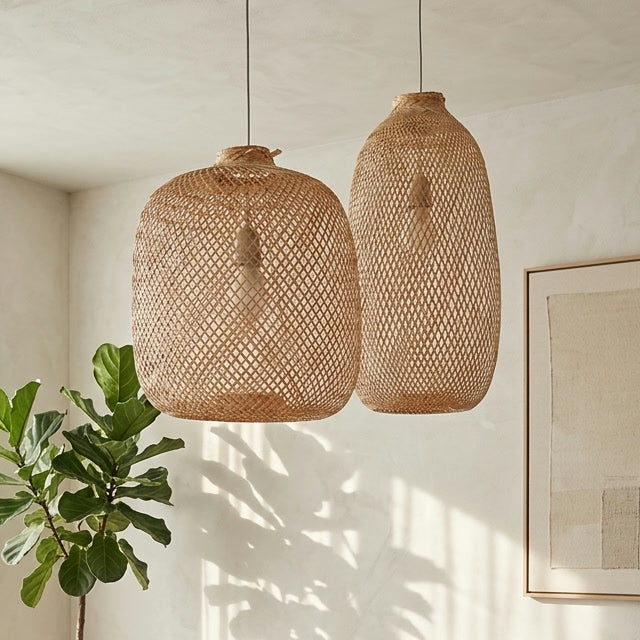
The style is usually described as favouring soft light, with shades and textured surfaces creating gradients and shadows rather than flat, even brightness. A woven pendant changes how a room looks after dark, so it's a sensible first choice if you're adding only one thing.
The TEERAYA bamboo pendant light shade is handwoven in Thailand from slender bamboo strips in an open diamond lattice. You press it into an elongated, rounded or compressed shape and tie it with the string provided, so the final shape is partly yours. It comes in seven sizes, from 35 cm / 14 in to 83 cm / 33 in tall, and its listing notes that colour, weave pattern and dimensions vary slightly. With a warm white bulb, the open weave casts soft patterned shadows across the wall. It comes with hanging hardware; the cord set and bulb are not included.
For a smaller spot, the JUNDARA round bamboo pendant light is a globe handwoven in Thailand's Isan region. It comes in five sizes, from 18 cm / 7 in to 35 cm / 14 in tall, in Natural, Brown or Black. Its listing suggests a single shade above a bedside table, or a group hung at different heights over a dining table or kitchen island. With a warm white bulb, the Natural finish glows honey gold through the weave. The listing notes the same slight variation in colour, weave and size; cord set and bulb not included.
The CHU JAI rattan and bamboo pendant light shade is handwoven in Thailand from both fibres. At 20 cm / 8 in high and 33 cm / 13 in across, it's wider than it is tall. Its listing says each shade is handwoven, so each one is unique. The bulb is not included and the cord set is sold separately.
To choose a size, measure the drop from the ceiling to where you want the shade's lower edge, and the width you can spare, then compare with the listed heights and diameters. Handmade sizes vary slightly, so leave a little margin.
More shapes are in our wabi sabi bamboo pendant lights collection. For fitting one, see our guide on how to install a bamboo pendant light.
One textured piece on the wall
On a wall, choose one piece or one small group and leave plain wall around it, so it reads as a focal point rather than as pattern.
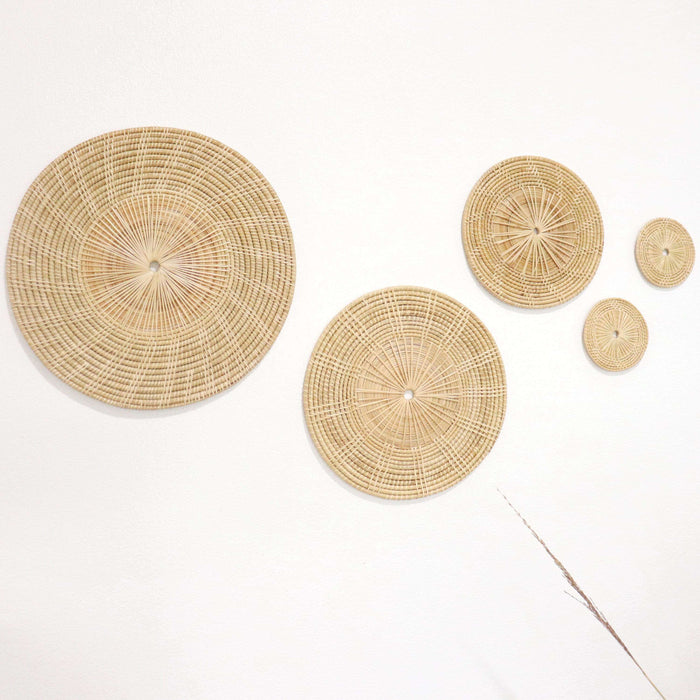
The NUTWADEE woven wall décor set has six plates handmade in Thailand from rattan, bamboo, seagrass and banana fibre, ranging from 7 cm to 33 cm (about 3 to 13 in) across. Four fibres in one group give you varied natural tones without adding any other colour, and the listing notes slight variations in size, shape and colour. Anchors and nails are included. Hang the six close together as one cluster. Other designs are in our rattan wall decor collection.
If three pieces suit your wall better than six, the SANSUK wall hanging set has three handcrafted pieces with decorative patterns, each 30 cm / 12 in in diameter, to hang together or on their own. Its listing notes slight differences in size, texture and finish between pieces.

Vessels and storage you leave out
In a kitchen, the handmade ceramics you already use can live on an open shelf instead of behind a cupboard door.
For a single vessel, the RA NI ceramic and handwoven seagrass vase pairs a smooth ceramic body with handwoven seagrass, and stands 20 cm / 8 in high. Its listing suggests fresh flowers or dried botanicals on shelves, side tables and consoles, and notes slight variations in size, colour and weave. One branch or a few dried grasses is enough.

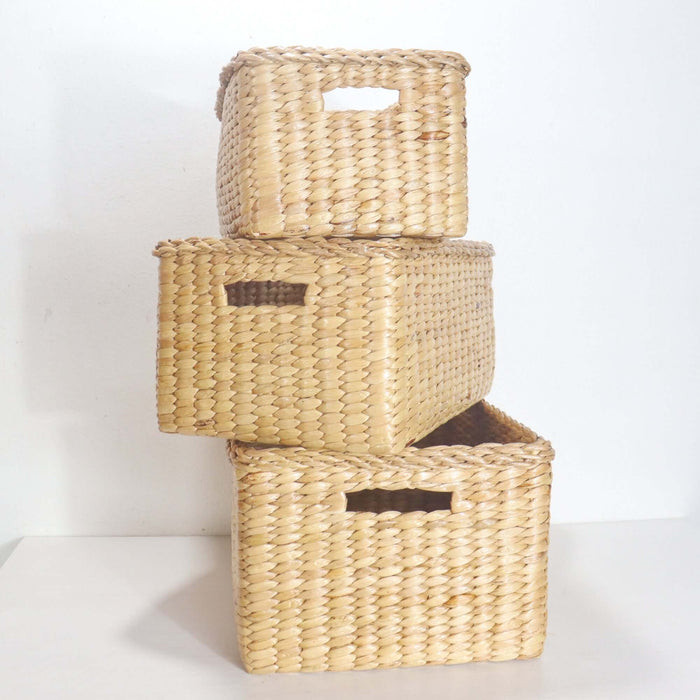
Storage can be part of the look too, as long as what's on show is the texture rather than the contents. The NALARAT seagrass basket boxes are woven by Thai artisans from natural seagrass in three sizes, from 15 x 31 x 20 cm (6 x 12.5 x 8 in) to 20 x 38 x 27 cm (8 x 15 x 11 in), height by length by width. Slight variations in tone and weave make each one a little different. On an open shelf, a box or two hides the clutter, so the shelf shows fewer things.
A simple formula for one shelf: one vessel, one box, and a stretch of bare shelf between them. More shapes are in our seagrass baskets collection, and if you're curious about the material, we explain what seagrass baskets are made of.

How to spot real handmade character when you shop
Because wabi sabi rests on visible handwork, read the listing before you buy. Look for:
- A variation note. A line saying that size, weave, colour or tone varies slightly from piece to piece. The seller is telling you to expect differences, and with this style that's the point.
- Made by hand, stated plainly. A line saying each piece is handwoven or handmade, ideally with where it was made.
- The material named. Bamboo, rattan, seagrass, banana fibre or ceramic, rather than a vague description of a natural style.
- Approximate measurements. Sizes listed as approximate, since handmade pieces differ slightly.
None of this is proof on its own. A note can be boilerplate, and some genuinely handwoven listings leave it out. But a listing that names the material, says the piece is made by hand and tells you to expect variation is being straight about what you're buying.
Keep, edit, add slowly
A common mistake is buying new things just to get the look. Start with what you already own, such as a worn wooden bowl or a basket you've had for years. Mend what needs mending. Then take things away until each surface has room.
When you do add something, add one piece for one spot. Live with it for a while before deciding on the next. Impermanence is the idea that things change, and a room can change slowly too.
Wabi sabi decor FAQs
What is wabi sabi decorating?
It's decorating around a Japanese idea of beauty in simplicity, imperfection and the passing of time. In practice, that means natural textures, handmade pieces with small irregularities, earthy colours that don't need to match, and fewer things with space around them.
Does wabi sabi decor have to look old or worn?
No. Marks of age and use are welcome, but the aim isn't a shabby or neglected room. New pieces can suit the style when their materials and making are honest, and they don't need to be antiques or come from Japan.
What are the principles of wabi sabi?
There's no single fixed list. This guide uses the three ideas usually named: imperfection, impermanence and simplicity. Some guides give longer numbered lists. Treat any of them as one way of explaining the idea, not an official set of rules.