Japandi Decor Ideas: Where Natural Woven Pieces Fit in the Room
Where one natural woven piece can earn its place in a Japandi style room, from lighting and walls to the table, storage and cushions.

Japandi decor asks for very little. One design guide describes the style as minimal, functional design with a few chosen decorative pieces, not a room full of them. Yet the guides we checked also count natural materials and textures among its defining features. So the task is deciding where a single natural piece earns its place.
We go through five spots in turn: the light, the wall, the table, storage and soft furnishings. Each covers what the guides ask for, then the handwoven bamboo, rattan, sedge or pandanus pieces that fit. The rule running through all of it is ours, not the guides': one woven piece per spot, and only if it does a job.
What makes a room feel Japandi
Japandi mixes Japanese and Scandinavian design. One guide frames it as Japanese minimalism combined with Scandinavian warmth; another as two traditions that share simplicity and a closeness to nature. The three guides we checked keep returning to the same features:
- clean lines and simple shapes
- a decluttered room
- natural materials and textures
- muted, neutral colours
- pieces that do a job, with one guide rating usefulness on a par with decoration
Hold on to that last point. In this style, a woven piece that only decorates is the first thing to question.
Everything we suggest here is handmade in Thailand. None of it is Japanese or Scandinavian, and we do not sell it as Japandi. If a piece suits the look, that comes down to its material, colour or shape, and we flag where the guides back that up and where it is our own judgement.
The palette and materials
The guides share a muted, neutral base with natural wood tones, light or dark. Accents are where they part ways. One mixes pearl grey and white with sky blue, pale pink and a touch of black. Another sets earthy browns and greens against soft whites and creams. The third just calls the tones muted. With no agreement there, pick accents that suit your room and keep the base quiet. A woven piece in its natural colour adds texture without adding another accent, which is why we left patterned and coloured pieces out.
On materials, one guide lists rattan, paper, stone, cotton and natural wood; another, linen, wool, ceramics and solid wood. Bamboo turns up in the examples: a natural bamboo pendant in one guide, bamboo utensil holders and bath mats in another.
The guides don't name sedge or pandanus. We include them because they are natural fibres with a visible woven texture, which fits the natural materials the guides describe. Torn between fibres? See how rattan, bamboo and seagrass compare.
Lighting: one simple woven pendant
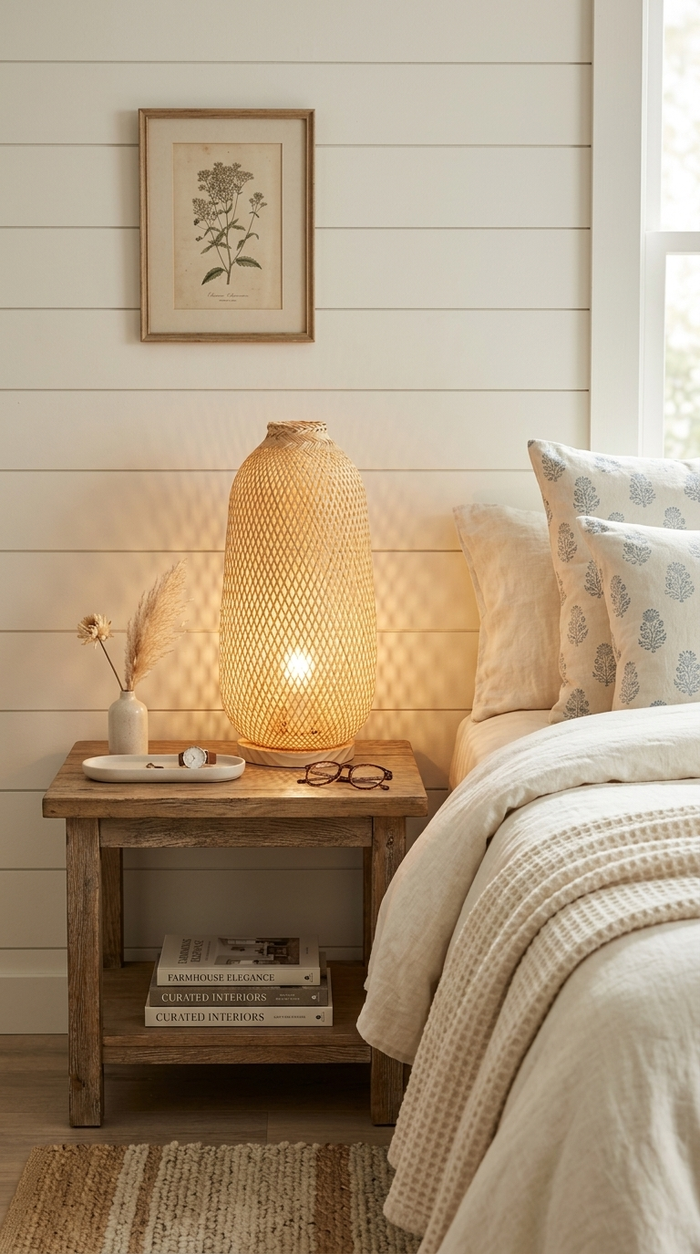
For Japandi lighting, one guide's advice is restraint: a simple shape with plain lines that contrasts with the room rather than dominating it. Its example is a natural bamboo pendant. Another leans on daylight and plain, neutral table lamps. In our view, a bamboo or rattan pendant fits that brief through its natural material and plain outline, as long as it is the only woven light in that spot.
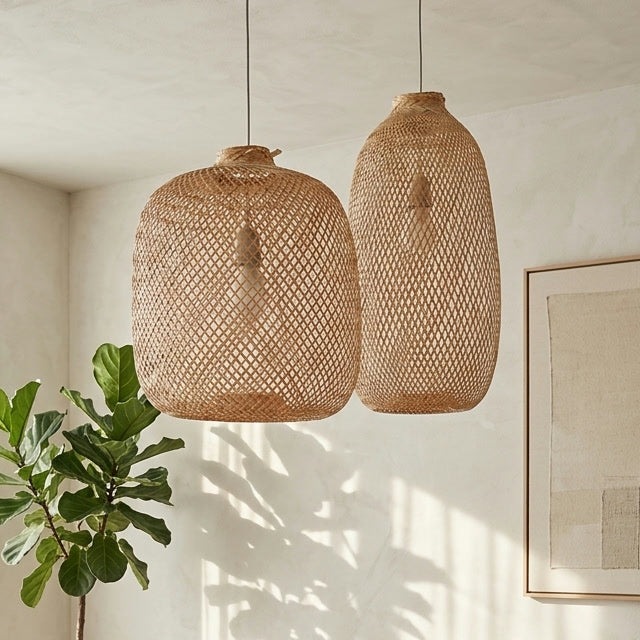
The TEERAYA Bamboo Pendant Light Shade (Flexible Design) is handwoven from slender bamboo strips in an open diamond lattice. You press it into an elongated, rounded or softly compressed shape and tie it with the string provided. It is listed in seven sizes, XS to XXXL, from 35 cm (14 in) to 83 cm (33 in) tall, and comes with hanging hardware.
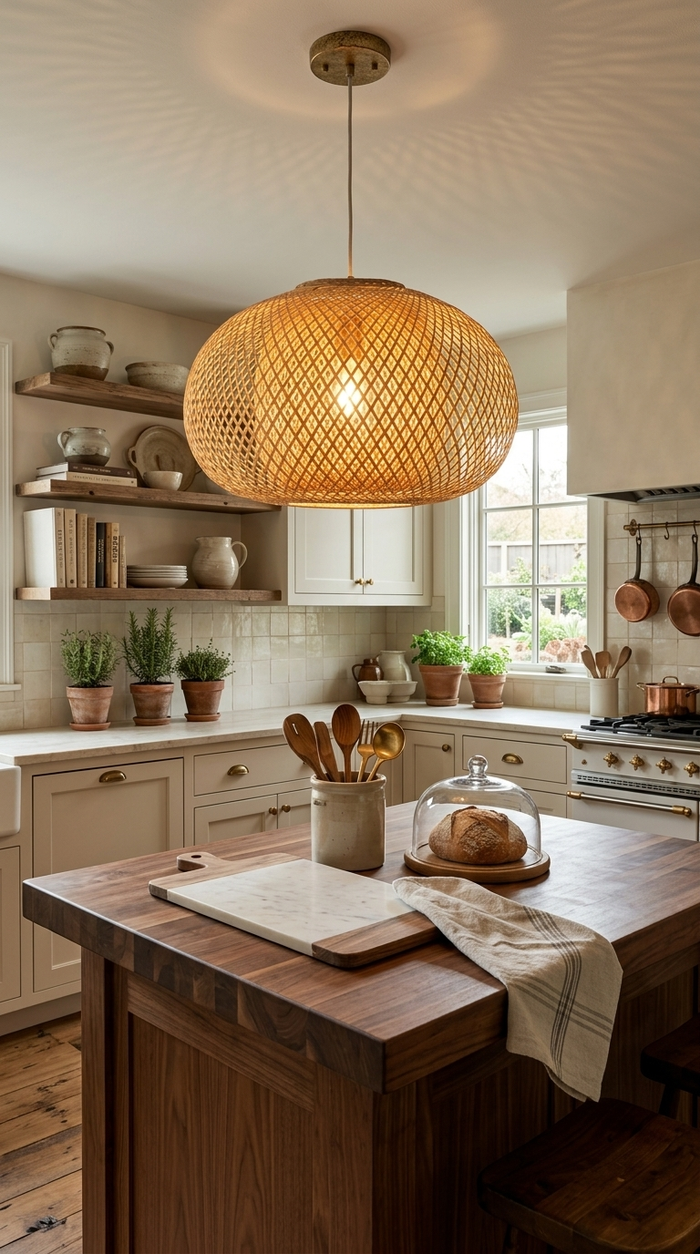
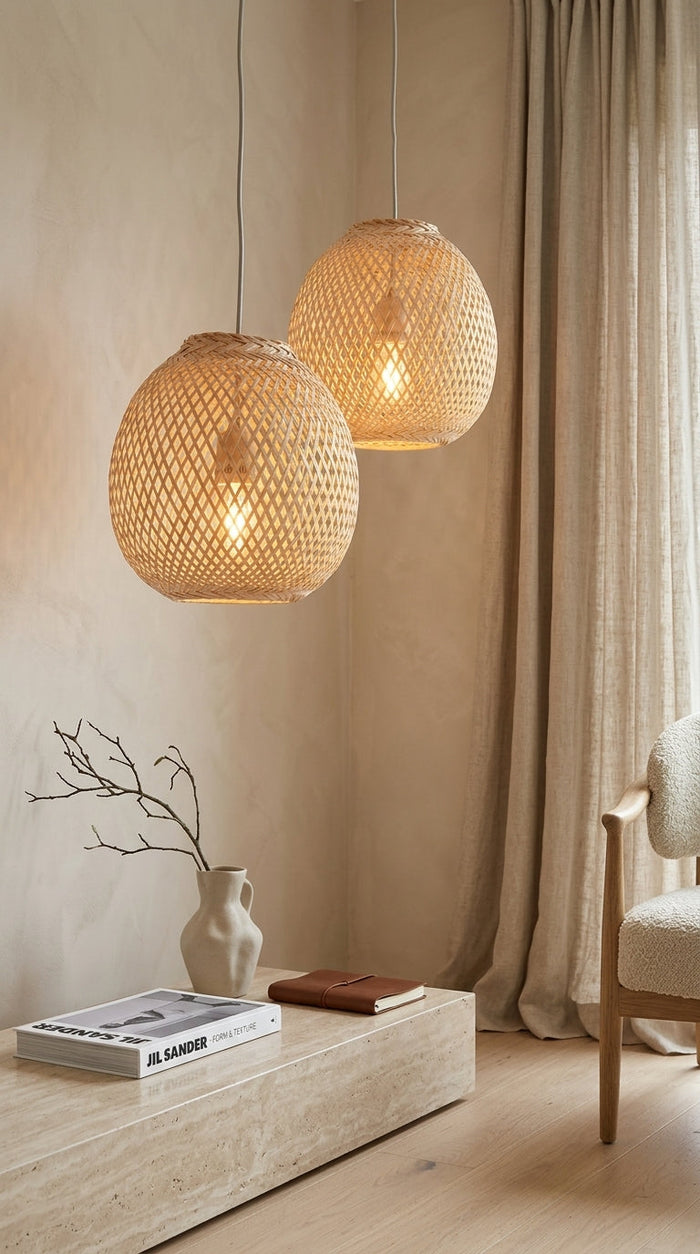
If you want something low and wide, the KAN WIN Wicker Rattan Pendant Light is handwoven from natural wicker rattan in one size: 20 cm (8 in) high and 38 cm (15 in) across. Its listing suggests dining tables, kitchen islands, bedrooms, living rooms and reading corners. The smaller, rounder option is the JUNDARA Round Bamboo Pendant Light, a globe handwoven in Thailand's Isan region and listed in five sizes from 18 cm (7 in) to 35 cm (14 in) tall, in our bamboo pendant lighting collection.

Each comes with its hanging hardware, but none includes a bulb or cord set, and the KAN WIN listing adds that electrical fittings are not included. Our pendant lampshade size guide helps with choosing a size.
Walls: keep it to one quiet piece
One guide suggests neutral wall colours that reflect daylight. Another describes wall decor in the style as minimal, able to catch the eye without crowding the room. Taken together, they make plain wall space part of the look.
That makes the wall the easiest spot to overdo. A cluster of woven baskets reads as a feature wall, and that pulls against the restraint. For texture, hang a single piece from our wall baskets, leave clear wall around it, and let it be the only decoration on that wall.
The table: natural texture under everyday objects
Picture the Japandi coffee table one guide describes: a teapot, a pile of books, ceramic cups and vases. Its kitchen has bamboo utensil holders, wooden cutting boards and ceramic bowls. Most of it gets used. That is the functional point in practice.
A woven placemat passes the same test. It works under plates every day instead of sitting there as an ornament. The Lana natural handwoven placemat is woven entirely from natural sedge fibres in a 46 cm (18 in) by 36 cm (14 in) rectangle. Its listing describes a neutral colour palette and says to wipe it with a damp cloth. If you browse our woven placemats, stick to plain, natural colours.

Our guide on how to style a coffee table covers the rest. For a Japandi version, make every object on it one you actually use.
Storage that earns its place
Of the five spots, this is where a woven piece has the clearest job, in our view. One guide puts functional accessories and a decluttered room on its list of key elements; another wants less clutter at the entryway and clear bathroom countertops. A basket that gathers loose things off a surface serves both ideas. A basket that holds nothing is one more object.
The Nattalee Oval Pandanus Basket Natural is handwoven in Thailand from krajood (pandanus) in a pale, honey toned natural colour. It is a low, open oval with no handles, 33 cm (13 in) long, 20 cm (8 in) wide and 10 cm (4 in) high.

The JUNTRA Round Rattan Basket is handwoven from natural rattan and comes in two listed sizes, Small at 12 cm (5 in) across and Large at 25 cm (10 in). Its listing suggests tabletops, shelves, bathrooms, kitchens and entryways, which covers both spots that second guide wants kept clear.
If neither suits, browse our storage baskets. Whichever you pick, give it a job before you give it a shelf.
Cushions and soft furnishings
For a Japandi living room, one guide pictures a sofa dressed mainly in neutral toned cushions. Another names beige, off white and muted grey fabrics, and counts blankets and linen pillowcases among its accessories.
If the room already has a woven pendant or basket, let the cushions stay quiet. Looking through our handmade cushion covers? Choose plain covers in neutral colours, and fewer of them. The guide that describes neutral cushions also favours fewer, better pieces.
Keeping it uncluttered
This look is easy to lose one piece at a time. Before adding anything woven, ask:
- Does it do a job, such as holding, lighting or protecting something?
- Is it the only woven piece in that spot?
- Does its colour sit inside your neutral base?
- Could you remove something else instead?
One guide's bedroom advice is to keep the room tidy and light in colour. Our rule of one piece per spot, function first, is a way to do that.
Start with the spot where something already needs a light or a home. Live with that piece before choosing the next.
FAQs
Do rattan and bamboo work in a Japandi room?
Yes, within limits. One guide names rattan among the materials of a Japandi room, and bamboo appears in two guides' examples, from a pendant to utensil holders. Keep the pieces few and plainly shaped, in natural colours, and make sure each one does a job.
Is Japandi the same as wabi-sabi?
No. One guide treats them as distinct, describing wabi-sabi as centred on the beauty found in natural imperfection. This article sticks to the Japandi features the guides share: clean lines, natural materials, muted colours and an uncluttered room.
Do Japandi pieces have to come from Japan or Scandinavia?
The guides we checked describe the look by its lines, palette, natural materials and restraint rather than by where pieces come from. Our pieces are handmade in Thailand, and we do not call them Japanese, Scandinavian or Japandi. If they suit your room, it is because of their material, colour and shape.