What Is Bamboo? The Grass Behind Woven Lamps and Baskets
Bamboo is a tall grass, not a tree, and not a true wood. Here is how its hollow stems become the woven strips in lampshades and baskets, how it differs from ratta...

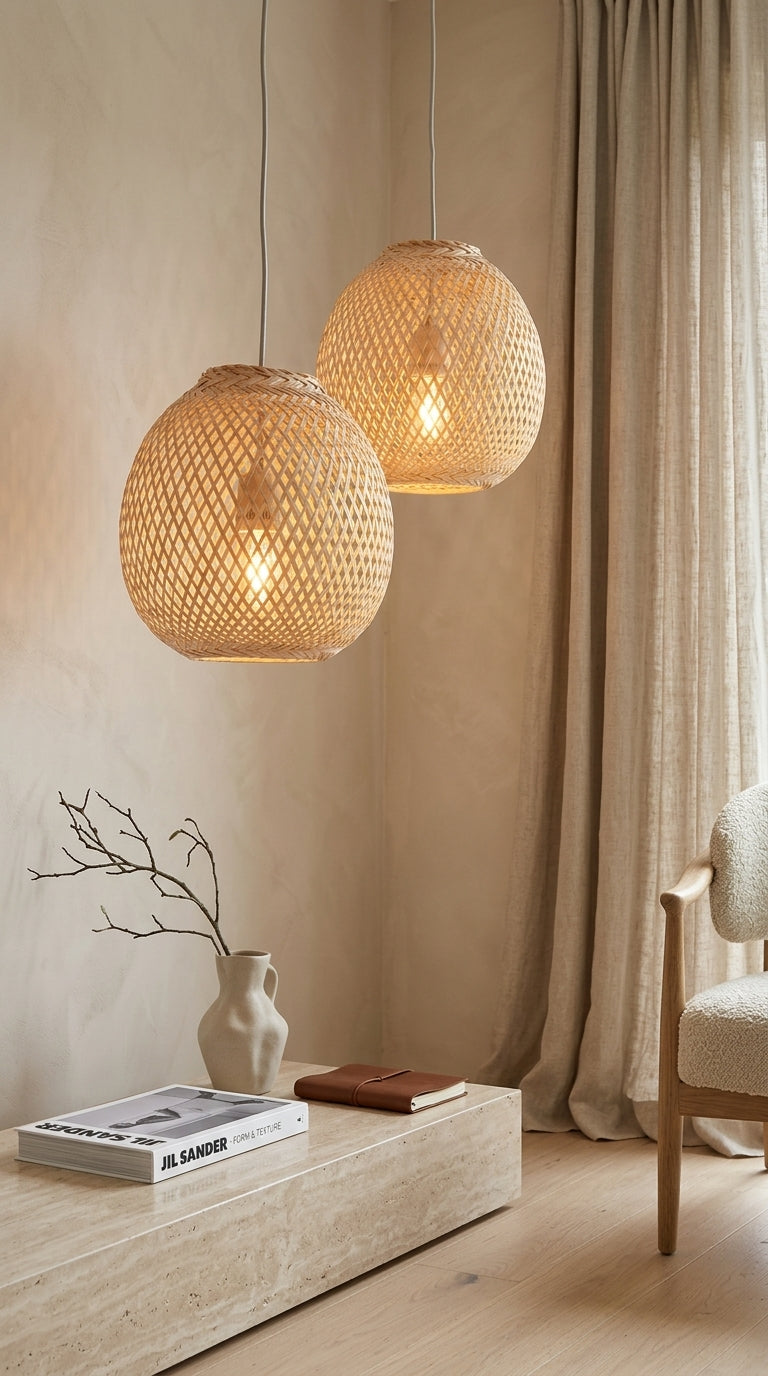
Bamboo is a tall grass, not a tree. Its stems are typically hollow and divided by joints, and although they look and feel woody, bamboo is not a true wood. So a bamboo lampshade or basket is made of strips of grass stem, woven into shape. Ours are woven by hand in Thailand.
This guide explains why bamboo is a grass and why it doesn't count as wood, how a hollow stem becomes the slender strips in a woven shade, where bamboo turns up around the home, and how to clean a bamboo piece without damaging it.
Bamboo is a grass, not a tree
Botanists place bamboo in its own subfamily within the grass family, Poaceae. Britannica describes bamboos as tall, treelike grasses, and that phrase explains the confusion. They look like trees but belong with the grasses.
Three plain terms describe the plant:
- Culm. The stem. This is the part that gets split and worked into furniture, baskets and woven shades.
- Node. One of the rings, or joints, along the culm. Between one node and the next, the culm is typically hollow.
- Rhizome. An underground stem. The culms grow up from it in branching clusters.
Bamboo grows in tropical and subtropical regions and on into milder temperate ones, with the largest number of species in East and Southeast Asia. That includes Thailand, where every piece we sell is handmade.
You will see very different figures quoted for how many kinds of bamboo exist and how fast it grows. The reference sources we checked don't agree with one another, so we have left the numbers out rather than pick one.
Is bamboo a wood?
Not a true wood. The stems are woody, and Britannica uses that very word for them, but as the American Bamboo Society's definition of bamboo explains, bamboo lacks the true wood that trees produce.
Wood, in the botanical sense, is what a tree adds as its trunk thickens. Bamboo doesn't make it, so its stem doesn't widen the way a trunk does. It stays roughly column-shaped along its length instead of tapering.
The mix-up is understandable, because bamboo does many of wood's jobs. Its stems are split to make furniture and flooring, and strips of dried, planed and glued bamboo are used as a wood substitute in flooring and carpentry. A wood substitute, though, is still a grass.
If you are buying a bamboo shade or basket, you are buying a woven grass. Compare it with other woven plant materials such as rattan, not with a carved or turned piece of timber.
From stem to woven strip
Oxford University's Plants 400 profile of bamboo notes that the culms are easily split, woven, twisted and bent, and those are the qualities weaving needs.
A stem that splits easily can be made into slender strips, and strips that bend and weave can be shaped into a curved shade or a basket. Our TEERAYA and JUNDARA pendant listings describe the finished pieces in just those terms: handwoven in Thailand from slender bamboo strips.

Every light we sell is handwoven by a named Thai artisan, and our bamboo comes from the same villages we have worked with for over two decades. Handwork shows in the result. Both pendant listings note that because each shade is handcrafted from natural bamboo, its colour, weave pattern and dimensions vary slightly, so no two are quite identical.

Where you'll find bamboo at home
Across our range, bamboo shows up in hanging lights, lamps, wall pieces and baskets. The bamboo pendant lighting collection is the place to browse hanging shades. Here is what the listings say about four of our bamboo lights.
| Light | Made from (listing wording) | Sizes | What's included | Stated use |
|---|---|---|---|---|
| TEERAYA pendant shade | Handwoven in Thailand from slender bamboo strips | XS to XXXL, 35 to 83 cm (14 to 33 in) tall | Shade and hanging hardware; cord set and bulb not included | Indoors |
| JUNDARA round pendant | Handwoven in Thailand's Isan region from slender bamboo strips | XS to XL, 18 to 35 cm (7 to 14 in) tall | Hanging hardware; cord set and bulb not included | Indoors, as a single pendant or in clusters |
| LUCK floor lamp | Natural bamboo, handwoven by artisans in Thailand | XS to XL, 48 to 76 cm (19 to 30 in) tall | Socket, cord, switch and plug; bulb not included | Not stated |
| JUM NEAN wall sconce | Handmade from natural bamboo | Small to large, 38 to 48 cm (15 to 19 in) tall | Plug-in cord in your chosen plug type; bulb not included | Not stated |
LUCK's shape is inspired by traditional Thai fishing trap baskets, a working bamboo form brought indoors.

Before you buy a bamboo light, check three things on the listing: the size, what's included and the stated use. The pendants above need a cord set and a bulb, while LUCK is ready to use once you add a bulb. Only the two pendants state a use, and it is indoors. None of these four lights is listed for outdoor use, so treat them all as indoor pieces.
Read the material line too, because not everything sold alongside bamboo is bamboo alone. The THANARA table lamp, for example, pairs a natural bamboo shade with a wicker base, and the NUTWADEE wall set mixes rattan, bamboo, seagrass and banana fibre. For walls beyond the sconce, browse our bamboo wall decor.
Baskets are the other everyday home for woven bamboo. BUABAN is a shallow basket 35 cm wide, handwoven from natural bamboo. Isaline is a round basket, also handwoven from natural bamboo, and WANTANA is a bread basket woven from bamboo. More are in our bamboo baskets collection.

Bamboo vs rattan, briefly
Bamboo and rattan both end up as woven lamps and baskets, so they are easy to confuse, but they come from different plants. Bamboo is a grass with usually hollow, jointed stems. Rattan is a climbing palm with solid stems.
For the palm's side of the story, read what rattan is. If you are choosing between materials for a shade or basket, our rattan vs bamboo vs seagrass comparison sets them side by side.
How to look after bamboo
The care wording on our listings is short and gentle. Put together, it comes to five steps.
- Dust regularly with a soft, dry cloth, a soft brush or a feather duster.
- Unplug a lamp before a deeper clean.
- If dusting isn't enough, wipe with a slightly damp cloth, not a wet one.
- Let the piece dry fully before you plug it back in or put it back in place.
- Avoid prolonged exposure to direct sunlight, rain and humid conditions.
Step 4 is the one to take seriously with lights. The LUCK listing asks you to let the lamp dry fully before you plug it back in, so give it time.
For a step-by-step look at cleaning a woven pendant shade, see our guide to cleaning a rattan pendant light. It was written for rattan, so where it differs from the care wording above, follow your bamboo listing. Bamboo steamers are a separate job because they get wet every time you cook with them, so they have their own guide to cleaning a bamboo steamer. Its advice is for steamers, not for lamps or wall pieces.
Frequently asked questions
Is bamboo a wood?
Not a true wood. Bamboo stems are woody, and bamboo strips are used as a wood substitute in flooring and carpentry, but bamboo is a grass without the true wood that trees produce. That is why its stems stay column-shaped instead of thickening and tapering like a tree trunk.
Is bamboo a tree or a grass?
A grass. It belongs to the grass family, Poaceae, even though its tall, ringed stems look treelike. The stems grow in clusters from an underground stem called a rhizome.
What is the difference between bamboo and rattan?
Bamboo is a grass with usually hollow, jointed stems, while rattan is a climbing palm with solid stems. Both are woven into lamps and baskets, so check the material line on a listing to know which one you are buying.
How do you clean a bamboo lampshade?
Switch off the light, and unplug it if it is a plug-in lamp. Dust the shade with a soft, dry cloth or brush. If it needs more, wipe it with a slightly damp cloth and let it dry fully before you use the light again. Keep it out of prolonged direct sunlight and humid conditions.