

Table Runner Size Guide: How Long and How Wide Yours Should Be
How to size a table runner by length and width, with a chart in cm and inches and a guide to which of our two handwoven runners fits your table.

A runner meant to hang over the ends that stops a few centimetres short looks as if it shrank in the wash. One far too long ends up in someone's lap. Two measurements prevent both. For length, take the top of your table and add a drop at each end. For width, start at about one third of the table's width. Below are the numbers in centimetres with inches alongside, for rectangular, round and square tables, for runners not meant to hang over, and for the two runners we sell.
How long should a table runner be?
Start with the top, not the table. Measure along the line the runner will lie on, edge to edge. If your table extends, measure it the way you will use it, because a runner sized for the table closed up will stop short once you open it out. Rounded corners and thick edges can also reduce the usable surface, so measure the flat top rather than trusting a listed table size. If one step trips you up, it is this one.
Next, add the drop (also called the overhang), the length of runner hanging past each end. Common guidance puts it at 15 to 30 cm (6 to 12 in) per end, so you add 30 to 60 cm (12 to 24 in) in total.
Some guidance sets a floor instead: at least 15 cm (6 in) over each end, so a runner at least 30 cm (12 in) longer than the table. One retailer guide's examples are a 183 cm (72 in) runner for tables 127 to 152 cm (50 to 60 in) long, and a 229 cm (90 in) runner for tables 183 cm (72 in) or longer. Treat these US retailer figures as a starting point, not a standard.
As a worked example, a top 180 cm (71 in) long needs 210 cm (83 in) with 15 cm (6 in) at each end, or 240 cm (94 in) with 30 cm (12 in) at each end. Anything in between fits the guidance.
Then check the drop from a chair. A long drop can look balanced on a big table yet catch on chair backs or knees. Hang a tape measure over the end at your chosen drop and sit in the end chair.
Over a tablecloth, the runner should not hang lower than the cloth.
How wide should a table runner be?
Measure the table from side to side and divide by three. A table 107 cm (42 in) wide gives about 36 cm (14 in).
Sources differ on width, so think in ranges. One guide calls 40 cm (16 in) typical, while common market widths run from about 30 to 45 cm (12 to 18 in). Your one third figure may not match a listed width, so look for the nearest.
On a narrow table, lean narrower. Plates and glasses sit outside the runner's edges, and a wide strip on a narrow top crowds them. Use one third as a place to start, then adjust. If woven placemats will share the table, see ten ways to decorate a dining table with woven placemats.
Table runner size chart (cm and inches)
Each row is the table top length plus 15 to 30 cm (6 to 12 in) at each end. The lengths are examples, not UK standard sizes, and inch figures are rounded. If your table falls between rows, add the drop to your own measurement.
| Table top length | Runner length |
|---|---|
| 90 cm (35 in) | 120 to 150 cm (47 to 59 in) |
| 120 cm (47 in) | 150 to 180 cm (59 to 71 in) |
| 150 cm (59 in) | 180 to 210 cm (71 to 83 in) |
| 180 cm (71 in) | 210 to 240 cm (83 to 94 in) |
| 210 cm (83 in) | 240 to 270 cm (94 to 106 in) |
For width, divide your table's width by three.
Round and square tables
On a round table the runner crosses the middle, so measure the diameter, add the drop at each end, and centre the runner so both ends fall evenly. A 122 cm (48 in) round table with 15 cm (6 in) at each end needs about 152 cm (60 in). Width can start at the diameter divided by three; go narrower if the strip crowds place settings or boxes in a centrepiece.
On a square table, lay the runner parallel to two opposite edges. A 107 cm (42 in) square table with 15 cm (6 in) at each end needs about 137 cm (54 in).
Runners that do not hang over: coffee tables, consoles and short runners
A runner does not have to hang over. A shorter one that stops before the edges is an option for a sleeker, more modern look. If yours comes up short of your calculated length, place it in the middle of the top as a centred panel, with no drop at the ends.
Runners also suit a console table in a hallway or a coffee table. The guides we checked give no figure for how much bare top to leave around a short runner, so measure the top and compare it with the runner's length.
On a long dining table, one or two short runners can go across the width instead, marking out places for serveware or a centrepiece. Here, compare the runner's length with the table's width.
Which of our two runners fits your table?
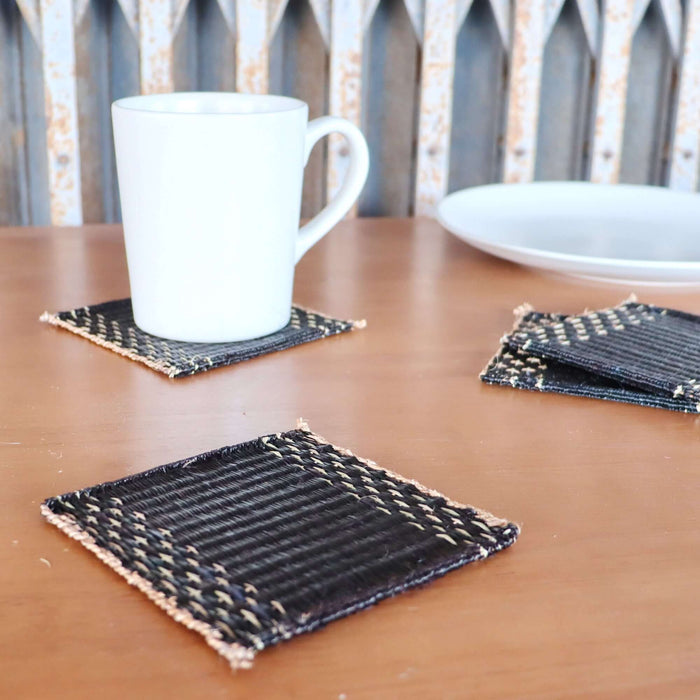
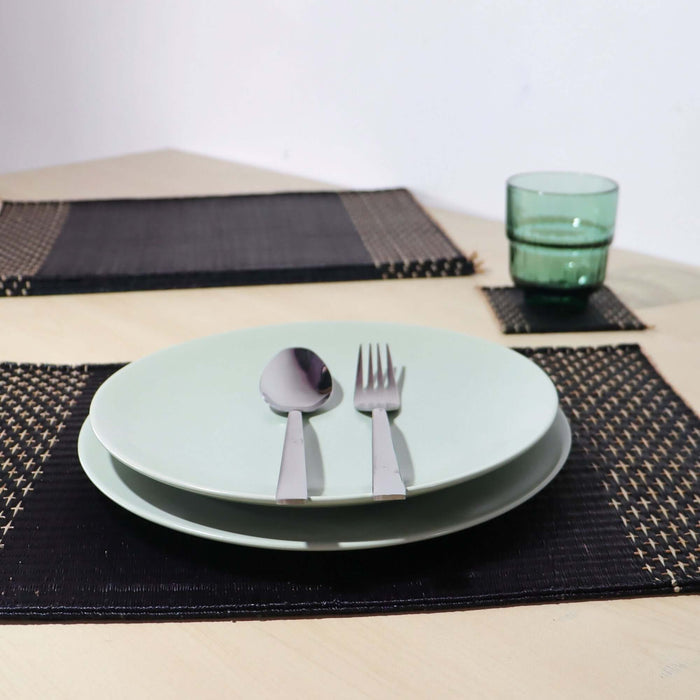
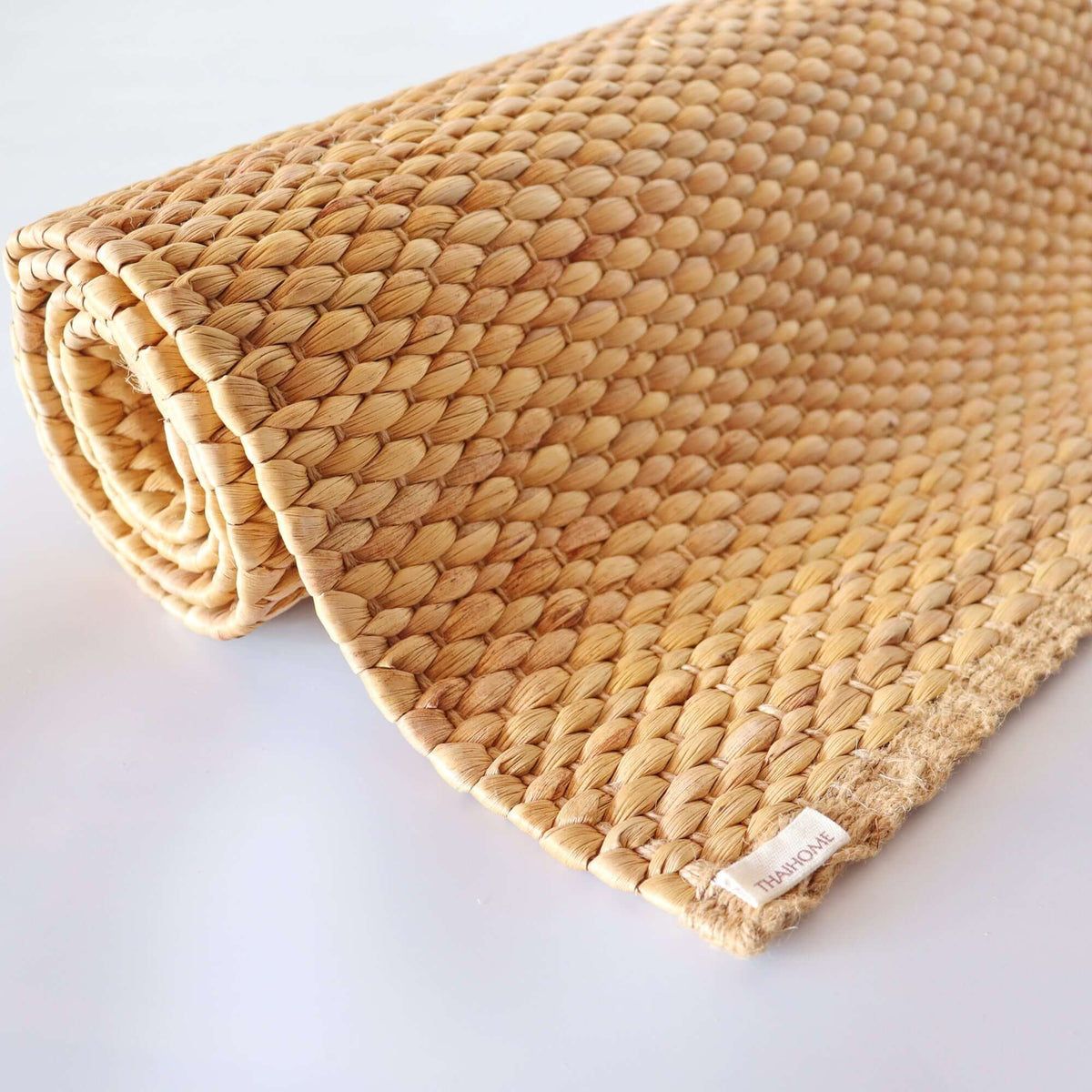
There are two runners in our table runners collection. The KAN TI CHA table runner is listed at 127 x 43 cm (50 x 17 in), and the LAVINLIA handwoven sedge runner in blue and natural at 150 x 30 cm (59 x 12 in). Both listings describe them for dining tables, consoles and coffee tables, and both are handmade in Thailand. The figures below are sums from the listed sizes, not fitting tests.
| Runner | Listed size | Lengthwise, 15 to 30 cm each end | Width by the one third rule |
|---|---|---|---|
| KAN TI CHA | 127 x 43 cm (50 x 17 in) | Table about 67 to 97 cm (26 to 38 in) long | One third of a table about 129 cm (51 in) wide |
| LAVINLIA | 150 x 30 cm (59 x 12 in) | Table about 90 to 120 cm (35 to 47 in) long, or round with that diameter | One third of a table about 90 cm (35 in) wide |
LAVINLIA is the simpler fit. On a table about 90 cm (35 in) wide and 90 to 120 cm (35 to 47 in) long, its length and width both line up with the rules. On a table 180 cm (71 in) long, though, the top is longer than the runner, so it reads as a centred panel rather than a runner with drop.

KAN TI CHA laid lengthwise cannot meet both rules on the same table. Its length suits a small table, but its width matches a wide one, and narrow tables are where the guidance says to trim width. Its 43 cm (17 in) does sit inside the common 30 to 45 cm (12 to 18 in) range. That leaves three ways to use it:
- Across the width of a dining table. On a table 90 cm (35 in) wide, it leaves about 18 cm (7 in) hanging over each side. That is plain arithmetic, not a drop rule, since the guidance covers the ends of a lengthwise runner. Those ends hang in front of seated guests, so do the chair check.
- On a console or coffee table, as its listing suggests. Compare your top with 127 cm (50 in).
- Lengthwise on a table 67 to 97 cm (26 to 38 in) long, accepting it will be wider than one third of the table.
Its listing notes slight variation between pieces, as each is handcrafted.

FAQs
Is there a standard table runner size?
No single standard. One guide calls 40 cm (16 in) a typical width, and common market sizes run about 30 to 45 cm (12 to 18 in) wide and 183 to 274 cm (72 to 108 in) long. Measuring your own table is more reliable.
What size runner do I need for a 6 seater table?
Seat count does not settle it. Tables sold as six seaters come in a range of lengths, and the seater figures we found were not consistent. Measure the top and use the chart above.
What if my table falls between sizes?
Any runner that leaves 15 to 30 cm (6 to 12 in) at each end is within the common guidance, so go up to the next length that keeps each drop at 30 cm (12 in) or less. Otherwise choose one clearly shorter than the top and centre it as a panel.
Can a table runner go over a tablecloth?
Yes, as long as the runner does not hang lower than the cloth.
Your two numbers
Measure the length and width of your top, then write down two numbers: the length plus 30 to 60 cm (12 to 24 in), and the width divided by three. Compare them with the chart, or with 127 x 43 cm and 150 x 30 cm.